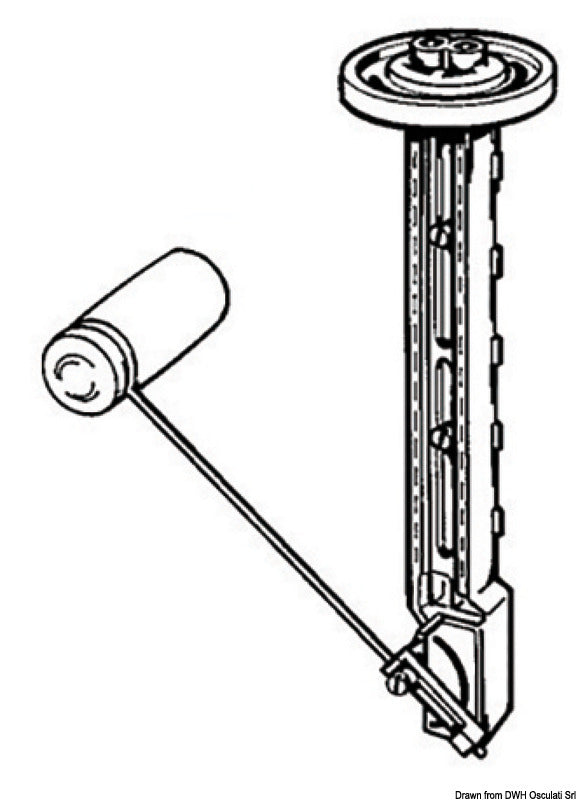
This VDO fuel level sender with adjustable float arm measures the fuel level in tanks with a depth of 150–605 mm. The sender converts the position of the float into a resistive signal, which is transmitted to a compatible electrical fuel gauge.
The sender is designed for 12/24 V systems and has a resistance range of 3–180 Ω. The signal value is 3 Ω ±1.5 Ω at an empty tank and 180 Ω ±12 Ω at a full tank. The electrical configuration features an isolated return, so the circuit is not dependent on the tank ground. The connection consists of two 6.3 × 0.8 mm blade terminals. The model is intended for a single gauge, has no warning contact, and does not provide NMEA 2000 data.
The sensor housing and float arm are adjusted according to the tank depth so that the float can move freely through the entire measuring range. The adjustable length of the sensor housing is 75–300 mm, while the effective radius of the float arm can be set from 94 to 378 mm. The sender can be used in fuel tanks for petrol and diesel, provided the instrument is compatible with the 3–180 Ω signal range.
Installation is performed from above through a tank opening of Ø60 mm. The asymmetrical SAE5 flange has five mounting holes on a pitch circle of Ø54 mm, and the mounting orientation must follow the flange geometry. The upper flange measures Ø72 mm, the connection part has a height of 79 mm, and the float measures Ø31 mm.
The sender is supplied complete with counter-flange set item no. 27.674.10, which includes two metal flange parts, two mounting gaskets, and screws. The gaskets and flange must be installed tightly, and the float arm must have free movement without contacting the tank sides or internal components.
During installation, the battery negative terminal must be disconnected, and the tank must be emptied and ventilated before cutting or drilling a new opening. Smoking, open flames, and other ignition sources must not be present during the work. The sender terminals must never be connected directly to the battery positive terminal; the connection must be made through a compatible fuel gauge according to the relevant wiring diagram.
Key featuresFor fuel tanks with a depth of 150–605 mm
Adjustable sensor housing and adjustable float arm
Resistive signal range: 3–180 Ω
Voltage: 12/24 V
Isolated electrical return
Two 6.3 × 0.8 mm blade terminals
SAE5 mounting with Ø54 mm pitch circle
Complete counter-flange set 27.674.10 included
For single instrument without warning contact
Operating temperature: −20 °C to +65 °C