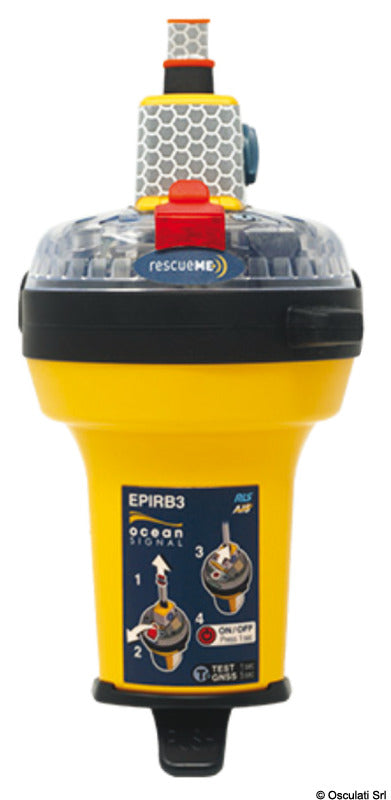
This manually activated EPIRB emergency beacon is an Ocean Signal rescueME EPIRB3 Category 2 for maritime emergency signaling. It transmits alarm and position data via the global Cospas-Sarsat/MEOSAR system and features an integrated 72-channel GNSS receiver with GPS, Galileo, and GLONASS.
The integrated AIS function broadcasts the EPIRB position on 161.975 and 162.025 MHz so that AIS-equipped vessels and rescue units within local VHF range can see the emergency beacon. Galileo Return Link Service provides visual confirmation when the emergency signal has been received and located, while NFC enables device status, beacon identity, and self-test results to be read with a compatible smartphone and the Ocean Signal app.
The emergency beacon transmits on 406.031 MHz with 12 W EIRP and also features a 121.5 MHz homing transmitter. A high-intensity white LED strobe light is supplemented by a separate infrared light for night vision equipment. The visible light has an average intensity of over 1 candela and flashes nominally 24 times per minute.
The Category 2 version is supplied with a manual quick-release bracket and does not deploy automatically upon submersion. After removal, the device can be activated manually or automatically by the water sensor when placed in the water. The water sensor is disabled while the EPIRB is in the bracket. The emergency beacon floats and is designed to operate vertically in the water with the antenna fully extended and a clear view of the sky. The integrated lanyard can be attached to a person, life raft, or lifeboat after activation.
The bracket must be mounted indoors, easily accessible, and at least 1 meter from the steering compass. It must also be placed away from strong magnets, radar antennas, communication antennas, and other strong RF sources. Three No. 6 × 3/4-inch countersunk mounting screws are included. The compact catalog dimensions are 173 × 91 × 79 mm, while the dimensions for the EPIRB itself, including the extended antenna, are 410 × 90 × 101 mm. The net weight of the EPIRB is 422 g.
The non-rechargeable LiFeS₂ battery provides over 48 hours of operation at -20 °C and has a 10-year replacement interval. The battery must be replaced after actual activation and serviced by an authorized battery service center. The device operates from -20 °C to +55 °C, withstands storage from -30 °C to +70 °C, and is waterproof down to 10 meters for 1 hour. It is MED-approved according to Directive 2014/90/EU and can be used on SOLAS vessels as a supplement to a required EPIRB3 Pro installation. The emergency beacon must be registered with the relevant national authority before use. Monthly self-testing is recommended. The manufacturer's warranty is 2 years and can be extended to 5 years upon product registration.
Key featuresManual Category 2 release with quick-release bracket
72-channel GNSS with GPS, Galileo, and GLONASS
Integrated AIS emergency signal on two VHF frequencies
Galileo RLS with visual reception confirmation
NFC connectivity for status and self-test history
406 MHz satellite signal and 121.5 MHz homing transmitter
White LED strobe light and separate infrared light
Over 48 hours of operation at -20 °C
10-year battery replacement interval
MED 2014/90/EU approved