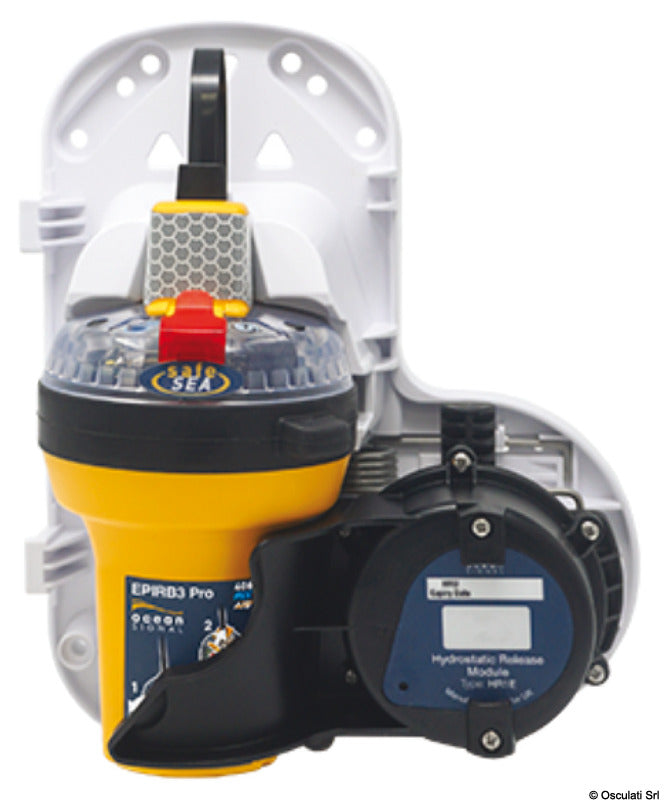
Ocean Signal Pro EPIRB with automatic float-free release in the EPIRB3 Pro model is a 406 MHz Cat 1 emergency beacon for recreational and commercial vessels. The unit is approved for SOLAS vessels and combines a Cospas-Sarsat emergency signal, AIS, 121.5 MHz homing signal, Return Link Service, and satellite positioning. The automatic housing is designed for exterior mounting and releases the EPIRB unit hydrostatically if the vessel sinks.
The integrated 72-channel GNSS receiver uses GPS, Galileo, and GLONASS to calculate the position, which is transmitted via the 406.031 MHz emergency signal. Simultaneously, the AIS function broadcasts position and status on 161.975 and 162.025 MHz, allowing AIS-equipped vessels within VHF range to see the emergency beacon as an AIS target. The separate 121.5 MHz signal supports local homing during the final search and rescue phase. The unit is also MEOSAR-compatible.
Return Link Service provides feedback via the Galileo system when the emergency signal and EPIRB identification have been received by the rescue system. Reception is indicated by a flashing blue indicator light. The 13.56 MHz NFC connection makes it possible to read programmed beacon information, battery status, test history, activation time, and GNSS test results using the Ocean Signal Product App for iOS and Android. The NFC function is powered by the phone and therefore does not require active radio communication from the EPIRB battery.
A white high-intensity LED strobe light and an infrared strobe light improve visual localization for both general viewing and night vision optics. The visible light has an average intensity of over 1 candela, while the IR light is specified at 15 mW/sr. The nominal flash rate is 24 flashes per minute. The unit floats in water, has a retractable antenna, and is supplied with a lanyard.
The EPIRB unit can operate for more than 48 hours at -20 °C and is rated for operation from -20 °C to +55 °C. The non-rechargeable lithium iron disulfide battery has a 10-year replacement interval and must be replaced after an actual activation or before the printed expiry date. Battery service must be performed by an authorized Ocean Signal battery service center. The beacon itself is waterproof to a depth of 10 meters for 1 hour, while the automatic release depth is a maximum of 4 meters.
The automatic release housing measures 237 × 191 × 121 mm, and the complete Cat 1 assembly weighs 1,252 g. The EPIRB unit itself measures 410 × 90 × 101 mm including antenna and weighs 422 g. The housing must be mounted externally and high on the vessel's superstructure with at least 150 mm of clear space around the holder and a clear path above it. At least 1.0 m distance to the steering compass must be maintained, and placement near powerful magnets, radar, and communication antennas must be avoided.
The holder has mounting holes that match older Ocean Signal E100/E100G installations. The included retrofit adapter also has hole patterns for the Jotron Tron 60S and McMurdo E5/G5. This applies only to the mounting holes and does not imply compatibility between the respective EPIRB units or hydrostatic releases. The delivery includes the Cat 1 EPIRB assembly, user and registration guide, labels, retrofit adapter, and six mounting screws.
Functional testing is recommended monthly, while GNSS testing is recommended at least every six months. The unit has a capacity for 60 GNSS tests over the battery's service life. The hydrostatic HR1E release, manufacturer no. 701S-00608, must be replaced two years after installation. The ARH1 Pro housing has manufacturer no. 703S-03414, and the approved LB14E battery service kit has manufacturer no. 703S-04031. Before use, the programmed 406 MHz EPIRB must be registered with the relevant national authority. The Cospas-Sarsat emergency system requires no subscription fee.
The product has a 2-year limited manufacturer's warranty, which can be extended to 5 years upon correct product registration. The EPIRB3 Pro is covered by the EU Marine Equipment Directive 2014/90/EU and relevant requirements for, among other things, Cospas-Sarsat, IEC 61097-2, and IEC 60945.
Key featuresAutomatic hydrostatic float-free release, Cat 1
406.031 MHz Cospas-Sarsat emergency signal with 12 W EIRP
AIS positioning on 161.975 and 162.025 MHz
121.5 MHz homing signal for local search
72-channel GNSS with GPS, Galileo, and GLONASS
Return Link Service with visual reception confirmation
NFC diagnostics via mobile app
White and infrared LED strobe light
More than 48 hours of operation at -20 °C
10-year battery replacement interval
MED 2014/90/EU-approved for SOLAS vessels