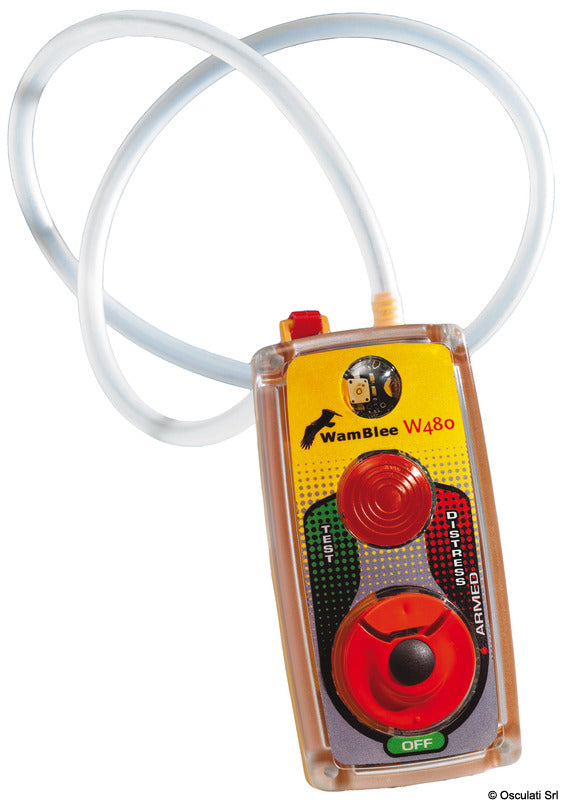
This AIS/DSC MOB emergency transmitter from Wamblee is model W480, a personal maritime radio emergency transmitter for locating a person overboard. The device combines AIS, DSC, and integrated GNSS into one Class M device classified as AMRD Group A, Type A.
The W480 transmits simultaneously on AIS 1, AIS 2, and DSC channel 70. The AIS messages include position, UTC, speed over ground, course over ground, device ID, and type 14 messages for active alarm and test. The integrated position receiver supports GNSS, GLONASS, and Galileo, and updates the position every minute. A compatible AIS receiver or chartplotter must be able to process AIS message type 14.
The DSC function supports both Open Loop and Closed Loop. In Closed Loop, the DSC call is first sent to the MMSI number stored in the device, after which the system switches to Open Loop after 12 minutes of operation. The vessel's MMSI can be programmed via NFC with the Wamblee Setup app on a compatible smartphone. AIS transmission continues after a DSC acknowledgment until the device is switched off or the batteries are depleted.
Activation can occur automatically via the water sensors on the back or manually using the large Test/Activation button when the device is in the ARMED position. Automatic activation occurs approximately 3–5 seconds after contact with water. A mechanical safety lock reduces the risk of accidental operation, and the buttons are designed for use with gloves. During installation, the water sensors must be freely accessible to water.
The device can be mounted on a self-inflating life jacket with a Velcro strap or the included clip for the life jacket's oral inflation tube. The antenna is routed along the life jacket and can be secured with the provided adhesive strips. The W480 can also be worn on sailing clothing or placed in a life raft or lifeboat. The life jacket manufacturer's installation instructions must always be followed.
The power supply consists of three replaceable 3 V LiMnO₂ batteries in 2/3 AA/CR123 format. The minimum operating time is 12 hours at −20 °C, and the batteries are normally replaced after five years if the device has not been activated. The test function checks battery status, the GNSS module, and AIS and DSC test transmission; the recommended test schedule is two functional tests per year. Approved batteries include Duracell CR123A/DL123A, Procell CR123A, and Energizer CR123A.
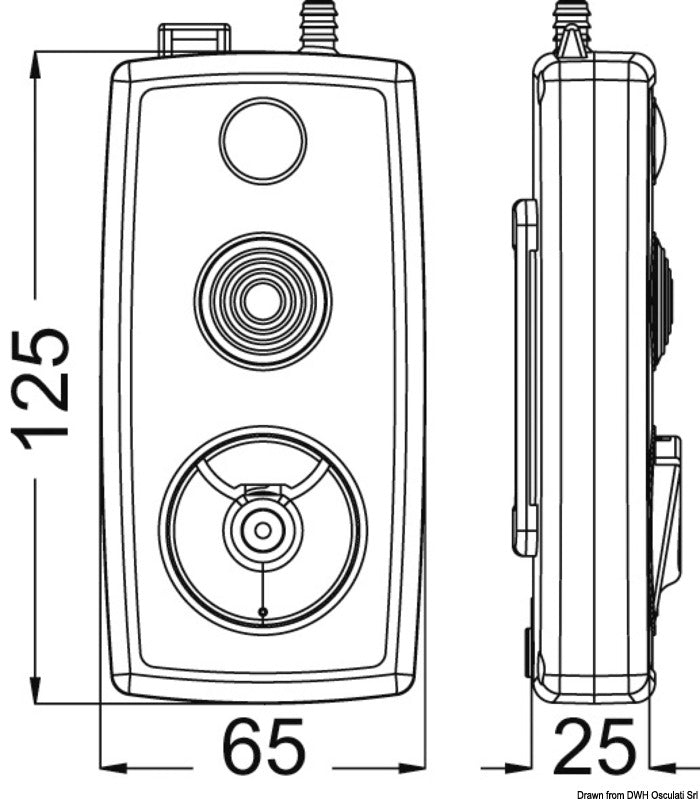
The product measures 125 × 65 × 25 mm without the antenna and weighs 140 g. The operating temperature is −20 °C to +55 °C, while the storage temperature is −30 °C to +70 °C. The integrated white LED has a brightness of over 0.8 cd and supports visual localization during poor visibility. The device is designed and manufactured in Italy and has a two-year manufacturer's warranty. Check national requirements for radio and ship station licenses before use, and keep the device at least 1.5 m away from magnetic sources and magnetically sensitive equipment.
Key featuresPersonal Class M AIS/DSC MOB emergency transmitter
AMRD Group A, Type A
AIS 1, AIS 2, and DSC channel 70
Open Loop and Closed Loop function
Integrated GNSS, GLONASS, and Galileo
Automatic water activation after approximately 3–5 seconds
Manual activation and built-in test function
NFC programming of MMSI via Wamblee Setup
Minimum 12 hours of operation at −20 °C
Dimensions 125 × 65 × 25 mm without antenna and weight 140 g